INTRODUCTION
CONTENTS: Components of four wheeler automobile – chassis and body – power unit – power transmission – rear wheel drive, front wheel drive, 4 wheel drive – types of automobile engines, engine construction, turbo charging and super charging – engine lubrication, splash and pressure lubrication systems, oil filters, oil pumps – crank case ventilation – engine service, reboring, decarbonisation, Nitriding of crank shaft.
Definition Of Automobile:
A self-propelled passenger vehicle that usually has four wheels and an internal-combustion engine, used for land transport. Also called as motorcar.
Example: Bus, Car,Lorry e.t.c.,

Components Of Automobile:
1) Body / Chassis
2) Power unit / Engine
3) Transmission System
4) Auxiliaries -Batteries, signal lights etc.,
5) Controls - Steering system , Braking System
6) Super structure- Any other with out frame
Chassis:

- Chassis is a French term which denotes the whole vehicle except body in case of heavy vehicles.
- In case of light vehicles of mono construction it denotes the whole body except additional fitting in the body.
- Chassis consists of engine,brakes,steering system & wheel mounted on the frame,differential,suspension.
Functions of chassis:
- To safely carry the maximum load.
- Holding all components together while driving.
- Accommodate twisting on even road surface.
- Endure shock loading.
- It must absorb engine & drive line torque.
1)conventional-forward chassis
- Engine is fitted in front of the driver cabin or driver seat such as in cars.
- Chassis portion can not be utilized for carrying passengers and goods
- Half portion of the engine is in the driver cabin & and remaining half is outside the cabin such as in TATA trucks
- In this arrangement a part of the chassis is utilized for carrying extra passengers
3)Full-forward chassis
- Complete engine is mounted inside the driver cabin
- Driver seat is just above the front wheel
Types Of Drives:
1) Front wheel drive
2) Rear wheel drive
3) 4 wheel drive
4 Wheel Drive explanation followed as :
1) Front wheel drive
2) Rear wheel drive
3) 4 wheel drive
4 Wheel Drive explanation followed as :
4 Wheel Drive Explanation
Comparison of Different wheel Drive types of an Automobile:
Just have a look in to the following lecture (Duration is less than 7 Minutes) to know about the different wheel drives and their pros & cons.
Wheel Drives comparison
Supercharging:
***Supercharging & Turbo charging***
Supercharging:
Supercharging is the process of introducing air in to an engine inlet above the atmospheric pressure by means of using a compressor. Generally the compressor is known as Supercharger / Pressure booster.

- The fresh air enters in to compressor where it is to be compressed above the atmospheric pressure (P1) , the final pressure of compressed air (P2) is surely high.
- The pressurized air is send in to engine inlet valve there after combustion chamber in order to increase the efficiency of the engine.
- The compressor draws the running power from engine crankshaft with the help of belt drive.
Advantages:
- Cheaper than turbo charger
- Increases engine output
- Regulate the pollution emmissions
- Quick acceleration of vehicle
- Vehicles cost increases compared to with out supercharged vehicle
- Engine design must be strong to resist extra pressure effects
- Supercharger consumes the running power from engine
Turbo charging:
Turbo charging is the process as similar to super charging ,but here the compressor is to be run with the exhaust gases energy by means of using a turbine. The device which consists of both compressor and turbine is known as turbo charger has to use here. The exhaust gases will move in to the turbo charger where the gases expands in turbine and the generated power utilizes to run the compressor. |The shaft which is connected to turbine with compressor is known as turbo shaft. Fresh air sucked in to the compressor which is to be further compressed and the same is to be send in to engine chamber.
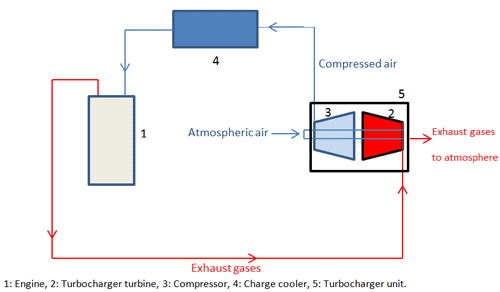
Advantages:
- The biggest upside of the turbocharged engine is that we can harness high power output by relatively small engine with good fuel economy.
- High power and torque can be obtained at. low rpm.
- No extra power supply is needed for operating the turbocharger unit because it utilize the waste energy of exhaust gases.
Disadvantages:
- The biggest downside is turbo lag which reduces the performance of the engine.
- Can't be used in single cylinder engine.
***Engine Lubrication***
- An automobile engine, engine oil/lubricating oil is used to reduce friction between pistons and cylinders so that pistons may slide up and down in the cylinders smoothly thereby avoiding wastage of fuel energy in overcoming friction.
- Lubricating oil reduces wear and tear in sliding/moving parts of machines thereby prolonging their life.
Splash Lubrication System:
The splash system is no longer used in automotive engines. It is widely used in small four-cycle engines for lawn mowers, outboard marine operation, and so on. In the splash lubricating system (fig.), oil is splashed up from the oil pan or oil trays in the lower part of the crankcase. The oil is thrown upward as droplets or fine mist and provides adequate lubrication to valve mechanisms, piston pins, cylinder walls, and piston rings. In the engine, dippers on the connecting-rod bearing caps enter the oil pan with each crankshaft revolution to produce the oil splash. A passage is drilled in each connecting rod from the dipper to the bearing to ensure lubrication. This system is too uncertain for automotive applications. One reason is that the level of oil in the crankcase will vary greatly the amount of lubrication received by the engine. A high level results in excess lubrication and oil consumption and a slightly low level results in inadequate lubrication and failure of the engine.

Advantages:
- Very cheap in cost
- Easy in construction
Disadvantages:
- This is not a positive lubrication system i.e we can not send the oil in to the deserve positions
Pressure Lubrication System:
In pressurized lubrication system, the lubricating oil is supplied by a pump under pressure to all parts requiring lubrication as shown in below figure. The oil under the pressure is supplied to main bearings of the crank shaft and camshaft. Holes drilled through the main crank shaft bearings journals, communicate oil to big end bearing and small end bearings through the hole drilled in the connecting rod. a pressure gauge is provided to confirm the circulation of oil to various parts.This system provides sufficient lubrication to all parts and is favoured by most of the engine manufacturers. This is used in most heavy duty and high-speed engines.

This comment has been removed by the author.
ReplyDelete